Category Archives: Lean Healthcare w Polsce
Andon system
Andon is a visual way of communicating by using light signals. When a issue is detected, a light signal appears and the production line can be stopped to remove the problem or the medical service may be interrupted. The main tool is an board that uses light signals or tones to tell where the problem appears. The signal can be used directly by medical personnel or a patient who felt worse and requires help. The signal can be sent by a remote located near the patient bed. There are two standard colors of signaling that are used – green and red. Every issue is serious and threatens the potential health or life of the patient, alarm activation is related to appearance of a red light signal. Medical personnel and patients should be aware of the usage and responsiveness of signals. Alarms should not be abused by patients or their families. Detection of issues (incorrectly set parameters for treatment) allows for removal, finding the source of the problem, introduction of improvements and also reducing the costs associated with patient complaints. In some hospitals, the number of alarm calls and stopping for medical services is monitored on a regular basis.
Internal communication
Internal communications is an important aspect that has an impact on the quality of provided services. Each participant passes his or her performed work to the next person in the process, providing important information, such as the patient’s vital parameters. The information should be transferred smoothly not only within the organization unit but also horizontally, passing through each department.
Vertical communication
Vertical communication is a contact between management and employees and vice versa. Information sent from management to subordinates most often concerns the segregation of duties, instructions and job instructions and information sent from subordinates to management includes requests, complaints, information, proposals, petitions or reports. Horizontal communication occurs between the same groups of employees, ie between nurses, doctors and administrative staff [Czerw i in. 2012]. In medical institutions occur direct and indirect contact. the direct contact consists of management communication with employees, conversations between administrative staff and medical staff, contact between medical staff, communication of medical staff with patients, communication between patients, management contact with persons unrelated to the company, ie suppliers, co-operators, competitors, there are also trainings, conferences and phone conversations. Direct contact include e-mail communications, leaflets and medical journals, boards for patients and staff, board information from patients to other patients and associations boards that provide information to patients, also letter communication, regulations and orders. By analyzing the communication process, it is possible to to identify many of its forms, which can be related to outdated and possible issues at work, it is important to identify factors that could disrupt the process. Barriers can occur on the sender side – by sending opposing signals to the receiver-due to prejudice and noise in the environment [Czerw i in. 2012].
Medical institutions may introduce brochures, flyers, and patient magazines on topics related to healthy living, nutrition and exercises. While waiting for a medical visit, the patient may read about diet, kidney disease, patient’s rights and medical ethics.
Boards as one of the indirect forms of communication can be placed in different places because of the information included on them, their degree of sensitivity as well as the different target audience. The board can contain:
- General information about reception times, insurance, services offered is located in the main lobby of the patient’s room, right at the entrance door; every person in the main lobby has access to this board.
- Information about health education of patients on dialysis and patients with kidney disease is located near the nephrological clinic. It is important that information is prepared by patients in consultation with management. This allows to present in a simple and comprehensible way the issues that every patient should know.
- Information about associations, undertaken initiatives, contact, photojournalism from events is placed on the wall at the entrance to the dialysis room.
- Information In the part reserved for the staff may be about ISO 9001 but confidential, sensitive information can be found on the tables in the doctor’s office and the medicine preparation room in the ward.
- Each patient, depending on the disease progression, has access to the selected information. Telephone communication is not enough when it is needed to convey visual information or documents.
Management can implement a modern information flow system based on the use of modern technology – intranet. It is an internal, private computer network that is adequately secured and separated from rest of the environment [slownik.infoweb 2013]. Access to information on the intranet platform may be determined by the administrator. Each employee has an individual login and password, range of content that they can view, load, edit or print, every new information on the platform is marked with a visible green color with the mention “new” or “changed”, thanks to it every employee knows the changes and can adjust to them. Information necessary for appropriate functioning, such as documents and procedures, can be accessed without additional passwords just by logging on to the computer. Any change made on the platform is identifiable. In functioning in distant units, fast communication is essential because it allow to access information at every location, ie at every unit equipped with computer with internet access, it allows to access to information at any time and by any staff member.
Access to actual information is essential to ensure proper patient care. Intranets allows to access content that improves work, sometimes it may be necessary to use the procedure entitled implementation of the patient to the medication program to be able to provide services in accordance with the contract with the National Health Fund and the rules change many times during the contract, which would require a meeting each time to discuss the changes and transfer of the modified formulas of the documents while destroying the printouts of the previous version. Patterns of medical documentation, forms or prints may be available on the intranet without memorizing or typing additional passwords (Permissions are granted by the administrator) so the nurse or doctor can use them without delay. Documents available on the intranet can be updated and each user receives information about the changes. The intranet allows standardization of procedures and documents, there are only current content in actual flow. The objective of Intranet is also to provide feedback in the form of sets, reports or statistics. For this purpose the e-mail system may also be used, particularly in the reporting from nurses to the human resources department and the management. There are also other modern forms of communication resulting from the principles of lean management of processes which should not be forgotten like shade tables in utility rooms or treatment rooms, horizontal signs on the floor indicating the storage areas for particular medical equipment such as wheelchairs. The separation of mop and wipes by coloring, the corresponding color is attributed to the type of dedicated surface to be cleaned.
Analysis of the communication process can be divided into communication on the lines of different occupational groups:
- Management – administrative staff
- Management – medical staff
- Doctors – nurses
- Management – patients
- Medical staff – patients
- Patients-patients
- Associations – patients
Incorrect co-operation between representatives of different occupational groups results in improper communication between people, as well as intergroup which may have an impact on the medical institution, the process of providing benefits which causes lower quality of functioning [Kęsy. 2012].
-
Analysis of communication on management – administration staff line.
Cooperation may involve direct verbal communication and the use of internal telephone communications; when required, management may send information by e-mail, employees responsible for specific places have assigned business addresses – which allows management to direct the information to the correct addresses by controlling the availability of mail. Communication between the management and the secretariat should be smooth and carried without interruption or delay.
-
Analysis of communication on management – medical staff line.
The most common form of communication is direct telephone conversation; Management can also use the intranet system to send actual communications, internal procedures and orders.
-
Analysis of communication on doctors-nurses line.
Currently working doctors should have continuous contact with nursing staff. The form of communication is morning doctor’s round, during the working shifts doctors also contact by telephone and cooperate directly within the therapeutic team to perform medical services together and complete medical records as well as plan specific medical actions to the discussed patients. The formal way of communication may be the records of medical orders and confirmation of their implementation in the individual documents of patients – so-called Individual (Medical) Order Sheets.
Quality of medical services
Medical service is a complex process that consists of medical examination, consultation, treatment and the aspects which cannot be noted tangibly. The aim of the service is to meet the properly determined needs of the customer, which should always be clearly defined. The problem, however, is the fact that the client reports to the medical facility with his subjective feelings which should be defined by the professional medical staff in terms of needs (necessary for the implementation of the actions improving the patient’s condition). It is an extremely important moment, because properly defined, necessary medical activities, presented to the patient or his authorized relatives, will be the object of the customer satisfaction evaluation during the further stages of the therapeutic-diagnostic process. If, at the very beginning, a doctor, a nurse or other member of the medical staff defines clearly all the necessary activities to the patient, he will observe and evaluate them. If a patient as the client does not receive information about the actions of the medical staff, he will not be able to make an objective assessment but he will subjectively express his concerns, sense of chaos, lack of sensitivity and coherence. The whole service, despite its effectiveness and substantive advantages, may be assessed negatively in the eyes of the patient since he has not felt an important part of the process whereas he should be its subject.
Medical service
In evaluation of the service, it is important for the customer to be satisfied which means the product meets the his expectations. Satisfaction is the variable and elusive experience so the assessment of the service is very subjective. Medical service is a health benefit, “which aim is to maintain, restore or improve the health together with other medical actions resulting from the treatment process or separate laws regulating the rules of their implementation” [the law of 15 April 2011].
Medical service is specific because of the insecurity and risk connected with the medical needs [Detyna 2011]. “In health care services, the offer is a declaration (identified with a particular contractor) readiness and willingness to reduce the sense of insecurity of the patient in the area of his health” [Bukowska-Piestrzyńska 2009]. Medical services differ in terms of the possibilities of using them, because every Polish citizen has the right to use financial benefits covered by the state budget if he has health insurance. The nature and number of the services in particular facility is often dictated by the terms of its contract with the National Health Fund. The demand for certain benefits is large and for certain – small. That is why the role of management is to match the range of services to the local market so the number of patients in need of treatment was as big as possible. The local market should be monitored in terms of morbidity and prevalence as well as epidemiological data and statistics of the population on a given area. For both residents and medical institutions it should be important to look for the niches and implement services in the field of health care. These niches can result from demographic changes as well as previously unrecognized needs of the community for medical care. The examples might be the growing population of the obese youth, a group of patients suffering from diabetes and its complications (particularly type II diabetes), as well as lower demand for specialized pediatric health care in small centres due to the small population growth, etc.
The quality of service depends on the staff
A doctor should support the patient, he specifies the treatment, decides what will bring greater advantages to the patient (is his agent). If the patient’s condition is so serious that he cannot make independent decisions, in the ideal situation it is a medic who makes decisions taking the best benefits, payment preferences and time into account. The role of the agent might lead to a conflict of interest, because the doctor as an entrepreneur also runs a business and his goal is to maintain high demand for his services. In some cases, a doctor may encourage his patient to use health benefits excessively, which does not improve the patient’s condition, but only boosts the profits of a doctor; in this way, a doctor has the possibility to take advantage of the patient, in order to increase his profits. Such phenomenon is called supply-induced demand and is not desirable in medical care facilities [Dobska 2008]. The demand is accompanied by the asymmetry of information between a healthcare provider and patient. The doctor uses a specific language, in contact with which the patient is illiterate.
In the study, it has been found that 75% of patients want to be informed about their health condition, regardless of whether this information is positive or negative, 91% of respondents want to know the diagnosis of the disease, 97% of patients want to know what are the next steps in the treatment process. A patient remembers 30% of the information provided by the doctor. To sum up, the physician should provide the most important information to the patient and his family (both positive and negative) [Laskowska and Tulińska 2006]. In Poland the National Health Fund is a monopolist in the market of payers for medical services from the public funds. The type of service depends primarily on the availability of medical staff (doctors, nurses, hospital porters, medical attendants), specialization of doctors, as well as infrastructure, socio-technical facilities, supply of medical surgeries and operating rooms, sanitary requirements obeying. Compliance with the law and safety standards is inherent in the provision of medical services.
Various factors affect the quality
The service is not the product of a specified size, it is a variable, and intangible product. In medical practice, certain part of the services requires the presence of the client (the operation), while part of the service can be made from a distance or indirectly, telemedicine or the extension of drug therapy through the prescription writing.
Impermanence of the service disenables buying it in advance, as well as the quality of implementation depends on the potential of employees and their involvement [Bukowska-Piestrzyńska 2009]. The realization of the service is undurable and meets the needs of a patient only for a limited time, depending on the attitude, examination findings, genetics, lifestyle and underwent illnesses. Treatment techniques are changing. The service, despite the same name and description of the procedure, may be different due to the knowledge and experience of a particular doctor, the use of available technology and also because of the patient and the cultural conditions.The service cannot be sold ahead, because it is consumed at the time of the performing, it consists of both intangible and tangible elements, and it is one-of-a-kind, since each time it is performed differently. There exist many factors that influence a particular service: patient’s feelings and mood, his attitude towards the doctor, the opinions about the medical facility and general information about the treatment, awareness of the possible complications, as well as the stress associated with the service realization and uncertainty about the effectiveness of the service. From the doctor, the service will vary, too, because each man is an individual of different characteristics to which you need to adjust the program of the service. The procedure can be one, however the way of realization can be totally different.
To sum up “the provision of medical care is one of a kind due to the attention which everybody pays to the health and its loss and the market of medical services is different from all other markets of goods and services because the value of the individual and social health is one of the most important issues” [Bukowska-Piestrzyńska 2009].
The quality of service is an important aspect of management in the medical industry. The quality in Latin is ‘qualitas’ so ‘a certain degree of excellence’ [Detyna 2011]. J. Oakland claimed that “quality as all the other complex issues needs to be constantly subject to observation in the light of the ongoing changes” [Detyna 2011]. Starting from quality, one should be careful not to commit one of the most common mistake, that is, defining quality in a way, which will be convenient for the company, but will not match the expectations of the client [Blikle 2011].
The ambiguity in understanding of the quality has let us to choose the most appropriate definition of the health services. According to “A guide for quality assurance in the hospital” there is an area of benefits “where the quality of the medical facility activity is the sum of the qualities of particular benefits” what allows to compare the quality assessments of several sectors or wards of the hospital.
Another perception of quality is the one perceived by the patient, according to his own experiences – a subjective perception [Dobska 2008]. External client-can assess the quality of medical services in relation to simple determinants – the actual features like: surgery time, waiting time, a sense of security and by the illusory characteristics such as: the environment in which the patient finds himself i.e. the building of the medical facility (generally speaking, infrastructure), access to the hospital, conversation with the staff – a receptionist and a doctor, the appearance of the employees and also the possibility of consultation for the patient’s family and reliability so the assurance that the service will be provided in agreed time. Each person reacts differently to therapy, and the effects of the therapy also vary, there is no 100% certainty to the techniques and methods of the treatment, so the reliability of the service is very subjective. A very important issue in medicine is the responsibility for the treatment process and examination using the medical competence and experience. A patient by choosing a particular medical facility shall aim at the sum of the service benefits [Detyna 2011].
The concept of quality in health services in Europe began to evolve in the second half of the 1980s [Dobska 2008]. Quality management is about taking actions to improve the quality of health benefits. It is based on the analysis of the health services quality, considering the opinions of the patients-customers on this topic, searching for effective and efficient methods of quality management. Quality provision is a certain philosophy of work that determines the activities in cases of any inconsistency, adverse events or mistakes since the medical processes, expenditures and time devoted to a patient are permanently monitored. Quality assessment is a detailed research on the quality of service, medical treatment and the effectiveness of the treatment. The tools that can be used are: patient satisfaction surveys, employee satisfaction surveys or direct interviews which will bring more information than mere filling out the survey [Dobska 2008].
To effectively work on the quality of medical services improving, you need to know the characteristics of the services and characteristics of the medical entities. The character of the medical service is the fact that it does not have a physical standard for evaluation. Quality consists of a certain degree of customer satisfaction and the fulfilment of his conscious and unconscious needs – the client will be satisfied when the quality of the actual and expected service is the same. According to Taguchi, quality is a loss handed over to the community, the lower is this loss the higher is the quality. Since time when some medical institutions were privatised, the increase in quality, as well as in the expectations of patients have been noted. This is the trend in the world economy – progress in product, technical and process innovations, new legislation such as the sanitary-epidemiological requirements, pharmaceutical progress, the rights of a patient, safety of data, the requirements of the payer (in Poland this is the National Health Fund, which works according to the Law of 27 August 2004, on the benefits of health care), the regulations on civil liability for quality of services and products. When the borders of the European Union have been opened, more residents migrated to other countries for medical purposes: to undergo a surgery, use the services of a dentist, be dialyzed. The experience of patients, awareness of other offices, hospitals and medical equipment condition, have made the customer conscious of the possible quality and he has experienced it once he now requires care on the same or even higher level of quality. In 2011 approximately 300 thousand. foreigners have benefited from medical services of a total value of 800 million PLN [OSOZ 2012]. Medical facilities are convinced that good quality improves the image of a company, improves its reputation, increases competitiveness in the local market. Work on the quality of medical services is a long-lasting process, whose effects are not immediately visible and sometimes they are intangible but still can be noticeable.
“No improvement can almost immediately be a real improvement, it becomes so only after certain time from the practical application” [Martyniak 2002].
The medical unit is trying to eliminate weak points, to improve quality standards and to mind reducing the costs of quality. It is important to collaborate with the staff, its motivation and awareness that poor quality costs more than good one. According to Edward Deming, work should be properly done “in the first place” so the staff should contribute to the reducing of the costs and to the quality by solid work taking the law, requirements and ethic into account. Such an attitude can reduce the number of complaints, boost the patient’s satisfaction and to improve the possibilities to extend the National Health Fund contract for medical services.
- The law of 15 April 2011 about the medical services, Dz.U. 15 February 2013, nr 217
- Detyna B., Detyna J.: Jakość Usług Medycznych, Ocena statystyczna Podstawy metodyczne, Warszawa 2011, Delfin
- Bukowska-Piestrzyńska A.: Pozytywna atrybucja usług zdrowotnych, University of Łódź 2009, http://uslugi.ue.poznan.pl/file/129_237561536.doc,
- Dobska M., Rogoziński K.: Podstawy zarządzania zakładem opieki zdrowotnej, Warszawa 2008, wydawnictwo naukowe PWN
- Laskowska E., Tulińska M.: Jakość relacji lekarz- pacjent i jej wpływ na proces zdrowienia in: Miscellanea, Neuroskop 2006, nr 8, pp 163-166
- Blikle A.: Doktryna Jakości, Warszawa 2011, http://www.firmyrodzinne.pl/konwersatorium-tqm/doktryna-jakosci.html
- Martyniak Z.: Nowe metody i koncepcje zarządzania, Kraków 2002, Wydawnictwo Akademii Ekonomicznej w Krakowie
Lean healthcare in the world
It was noted that the Lean Healthcare is not only a production system but also a system that refers to other departments of the company, including the management. In the 21st century, many lean management solutions have been used in hospitals to carry out activities related to health care and adapting the methodology to the specificity of health services – lean hospitals have emerged, especially in England and the United States. In Poland, it is still a field of undiscovered possibilities. Polish hospitals benefit from technical innovations directly related to medical equipment but not from innovations in the organization and management system. This is a great opportunity for most public hospitals that have credit obligations,, lack staff or materials for efficient functioning.
“Lean Healthcare system is a set of tools, management, and philosophy that can change the way hospitals are organized and managed. The Lean Healthcare is a method that allows hospitals to improve the quality of patient care by reducing the number of errors and reducing waiting times. The Lean system is a concept that can support doctors and other workers, eliminating their difficulties and enabling them to focus on those activities that serve to cure and care. This system helps to improve the organization of the hospital for a long time – by reducing costs and risks while increasing opportunities for growth and development. Lean hospitals help break the barriers between separated hospitals wards, which allow them to work better together for the benefit of the patients.” [Graban 2011].
The objective of lean hospitals is not a one-off solution to a single problem but a counteraction to many of them. Health care costs are rising faster than inflation that means spending exceeds available resources. Due to the rising costs of maintaining medical institutions and their employees, all forms of “improvement” are sought when the payer also has less money (In Poland it is The National Health Fund) and limits the amount of refunds by reducing own expenses and creates problems for providers. Real costs of services in most cases exceed their refund, which makes medical institutions loss millions of Polish złoty and their managements are forced to implement cost-effective cost-cutting methods – lean hospitals can effectively support them.
According to The Institute of Medicine, there are 400,000 injuries each year in US medical institutions that are caused by improperly administered medicine [NHS 2012]. In hospitals there is a possibility of elimination of processes that don’t affect the effectiveness of patient care. Sometimes it is a change of procedures, habits and sometimes putting the patient to another type of treatment, which means cheaper and less painful therapy. Medical institutions would work better if the results of treatment had an impact on the level and quality of contracts with the payer.
Below are presented some examples of hospitals in the world, that saved time and money by using lean hospitals methods:
- Avera McKennan Hospital in South Dakota shortened the hospitalization of patients by 29%, which allowed them to avoid a $ 1.25 million investment in a new emergency department building.
- At Allegheny Hospital in Pennsylvania, mortality was reduced by 95%, due to blood infection associated with central venous catheter.
- The ThedaCare Hospital in Wisconsin has implemented improvements to reduce patient waiting time for orthopedic treatments which shortened the waiting time from 14 weeks to 31 hours (from first visit after treatment).
Maintaining a good quality of service greatly reduces costs. One of the hospital’s financial directors in the US, Bill Douglas summarized the activities of lean hospitals as follow: “If your actions are focused on quality and patient safety, then you can’t lose”[Graban, 2011]. Each medical intuition has the possibility to reduce the cost of its activities, not necessarily with dismissal of employees or purchases of new devices, there are other solutions, but the lack of awareness of the management of medical institutions in this direction and lack of desire makes the institution struggling with problems that are difficult to solve. Lean hospitals can be a basic strategy for an entire medical institution by creating daily activities, both in self-employment and in the continuous monitoring of activities performed by employees.
Lean hospitals are a well-developed system in hospitals in England. Based on the publications of the NHS-Institute for Innovation and Improvement, the following lean management improvements will be discussed below.
- Poole NHS Trust Hospital in the UK in 2009 introduced many changes in the organization of work. To keep the documents intact, separate cabinets of different colors have been installed, blue for doctors and red for nurses. Reduced medicine delivery time to patients by average 100 minutes each morning by work of two nurses: This was possible thanks to the division of duties of two nurses. One nurse gave medicine to the patient and the other one was dealing with the patient’s medical records at that time. Patient identification was also introduced by the numbering the beds from 1 to 30 and their location, by placing additional information on the patient’s board (for example x-ray room). In order to save space, hospital wards have updated the state of bedding and returned 153 unnecessary pillows to laundry [NHS Case study 1].
- In the children Birmingham Children’s Hospital NHS Foundation Trust the process of patient information has been improved by issuing a booklet that informed about patient’s stay in the hospital ward and also included the most frequently asked questions by interview with young patients. This has helped to improve the comfort of the families of children in the hospital ward and reduced the time spent discussing the concerns with the doctors. There were a lot of mistakes in the medicine distribution process, so there was decision to visualize the medication carts for patients by labeling them in red. This resulted in that no one was bothering the nurses unless it was an urgent call. This has led to a decrease in the number of medicine distribution mistakes, improved patient safety, and increased patients trust due to the ability to talk without interruption [ NHS Case study 2].
- In Leicestershire Partnership NHS Trust hospital the visual condition of the institute was improved, the paintings were placed on the walls, so that the interiors became more cozy and warm. The waiting time for surgery was also reduced by 120 min [NHS Case study 3].
Examples of similar improvements in US hospitals:
- The Wisconsin’s Monroe Clinic hospital in US saved a lot of time by focusing on important and significant processes. The payment system for private medical services has been improved, so the hospital is paid after 6.5 hours and not after 12 hours.
The solution has enabled a possibility to disposal of greater cash which increased opportunities for service development and equipment purchases. Adopting a patient to the emergency ward now takes 10 minutes, and before the introduction of VSM, it took 3 hours to get there. It also reduced the process of reception and discharging the patient from the hospital from 125 minutes to 70 minutes by reducing the number of documents filled; Patient and hospital staff satisfaction has increased. It is a comfortable solution for the patient because he is less stressed by standing in queues, waiting, walking from the office to the office and also in the hospital there are no queues and unnecessary crowding [HPP Case study 1].
- In the Florida Hospital the main tool was mapping of value stream that improved the process, increasing patient satisfaction of nursing care by 86% compared to the previous year, increase in the satisfaction of hospital staff from work performed, reduction of time for daily activities (7000h per patient per year) and also it caused the reduction of calls to nurses by patients at night by 1700h per year [HPP Case study 2].
- In Oklahoma City Hospital focused on communication between the patient’s family and the hospital staff. By using boards and IT solutions which track a patient’s stay in hospital, the number of questions about patient place of residence reduced from 75 to 0 per day.
- The number of central venous catheter infections has also been reduced by implementing standardized procedures, VSM, purchase of better puncture packs and better communication among nurses [HPP Case Study 3].
- In Middle Tennesse Hospital nurses pathways were improved using a spaghetti diagram. It was found that the nurse needed 81 minutes to give the medicine to 3 patients. Only 26 minutes of that time was spent directly with the patient. Important time constituted only 31%, the rest was walking, logging into the system, looking for medicine. The medicine delivery time by nurses was also reduced from 45 min to 4 min per 1 nurse on working shift, by increasing the time spent with the patient by the nurse [HPP Case Study 4].
By Analyzing medical institutions, it is worth to observe the needs of Polish patients and on this basis perform improvements:
- Improve the organization of the reception room by shortening the time of formal activities.
- Improve communication with patients, systematically distribute patient leaflets with Patients’ rights
- Improve sanitary-hygienic conditions by adapting the bathrooms to the patients
- More precisely inform patients before surgery
By using the philosophy of lean hospitals it is important to understand of the value stream, it is the source of many information, new ideas and changes for the better. According to Womack and Jones, this is “a collection of all the activities required to produce a particular product (…) in a process of three critical task-management challenges that arise in every activity: product design, Information management (…) and finally Physical implementation of production”[Graban 2011]. When referring to medical activities, product design will be patient diagnosis and treatment plan, information managements will be the issuing of instructions to nurses and information about health status of the patient, patient’s disease history and instructions for further care and product realization will treatment of the patient. Although lean hospitals and improvements have been discussed for many years in Toyota, health care continues to suffer from the acquisition of implementation model and usage of the improvements of lean hospitals comparable to Toyota’s factories. Every hospital that has found Lean Healthcare has changed its philosophy of work, accomplishments in this area, found Muda and introduced improvements. A medical facility is like a human organism that lives its own life; there are no 100% duplicated schemes but there is adapting to the hospital’s operating profile. Therefore, organizations operating in the medical industry are learning from one another, taking each other as a example, but it is difficult to implement uniform and duplicated mechanisms. The healthcare industry as an economy that is spending more and more money, should implement better solutions and lean management is a tool that may make a lot of money and improve the competitiveness of the institute [Graban 2011].
- Graban M., 2011, Lean Hospitals: Improving Quality, Patient Safety and Employee Engagement, ProdPublishing, Wroclaw
- NHS Institute for Innovation and Improvement, 2012, Productive care case studies, staff improvements and leadership, South West, Poole Hospital http://webcache.googleusercontent.com/search?q=cache:PlA1mHDzkWkJ:system.improvement.nhs.uk/ImprovementSystem/ViewDocument.aspx%3Fpath%3DStroke%252FNational%252Fwebsite%252FGoing_up_a_gear%252FPost_Hospital%255B1%255D.pdf+&cd=3&hl=pl&ct=clnk&gl=pl,
- Putting patient first ,The productive series, 2012, NHS Institute for Innovation and Improvement, Case study 2, http://www.institute.nhs.uk/images/documents/Productives/Putting%20patients%20first%20-%20The%20Productive%20Series%20FINAL.pdf
- Putting patient first ,The productive series, 2012, NHS Institute for Innovation and Improvement, Case study 3,
- Streamlining Remittances to Improve One Hospital’s Cash Position, 2012, Healthcare Performance Partner, Case study 1, Xhttp://www.leanhealthcareexchange.com/wp-content/uploads/2011/03/HPP_CaseStudy_Remittance.pdf,
- Improving Satisfaction and Reducing Waste through Visual Management, 2012, Healthcare Performance Partner, Case study 2, http://www.leanhealthcareexchange.com/wp-content/uploads/2011/03/HPP_CaseStudy_Nursing_Satisfaction.pdf
- OR Tracking Event Answers Question : “Where’s my patient?”, 2012, Healthcare Performance Partner, Case study 3, http://www.leanhealthcareexchange.com/wp-content/uploads/2011/03/HPP_CaseStudy_OR_PatientTracking.pdf,
- Hospital Streamlines Medication Delivery, 2012, Healthcare Performance, Case study 4, Partner,http://www.leanhealthcareexchange.com/wpcontent/uploads/2011/03/HPP_CaseStudy_Pharm_Delivery.pdf
Methods of risk management
Each medical institution is struggling with high fixed and variable costs. In the risk of reducing the funds allocated for the realization of health services, it is worth to adapt lean healthcare and eliminate all sources of waste which generate high costs.
Below are examples of tools to minimize waste which occur in processes:
- KAIZEN
is a method of continuous improvement which consist of the search and implementation of little or small improvements, which are considered more efficient and cheaper than sporadic, large reorganizations of the company. The basis is kaizen form to which every employee of the company – both an office worker and an operator has access. The form is the basis for demonstrating a new idea that improves the process , work station or conveyor belt. The method allows all employees to be involved in improving the management of the company. Kaizen helps to shape the employee so that he looks for ways to better do perform his duties. It is important to allow employee to make changes and make him not afraid to offer improvements to the supervisors while focusing on the process [Robaszkiewicz 2006].
- Empowerment is transmission of authority and increase of employee permissions. This is one of the concepts of human resource management. It involves encouraging employees to make decisions, increase involvement in work and to take responsibility for his actions. Empowerment allows employee involvement in the process and suggesting his own improvements and ideas. The result of this concept is increasing the sense of belonging to the company, improved team relationships, feeling of responsibility and Increase of awareness of process costs. KAIZEN form can be a suitable instrument [mfiles 2013].
- 5S is a method of reorganizing workstations to increase work efficiency, systematization and arrangement of the workplace. This is a visual management system.
- JIT – just in time is the method in which required components and raw materials like disposable materials and medicines (for example Unit dose system, which allows the hospital to distribute medicine according to the patient’s current needs. The objective is to supply the patient with a single dose of medicine instead of the entire package which will not be used. This is the future of Polish hospitals) are delivered in a given production process on exact time. This method eliminates or minimizes component storage and most important – to minimize delivery time. Taiichi Ohno is considered to be the creator of it.
- JIS – just in sequence is modern sequential system, it aims to optimize and automate main processes so the parts used during the treatment process are delivered to the destination of medical services according to the order previously determined [psi 2013].
- VSM – value stream mapping
is a method of acquiring knowledge of the entire production and service process, which consists of drawing a process map and then improvement of it. It is a overall design process, starting with a project and creation of idea for its implementation [Rother i Shook, 1998]. The method allows you to understand the flow of materials and information, allows you to find the muda and its source. This is the only widespread instrument that shows the relationship between the flow of materials and information. The method uses a standard graphical language that is understandable to everyone who deals with VSM. With VSM you can concentrate on flow and create a vision of ideal, desired situation so-called – future state map. With starting of VSM it is needed to develop a state of the current map by collecting information directly from the place of production or service. The next step is to analyze the map and develop a future state map. It is important to remember and include customer requirements in any action that improves the process. The values characterizing the lean production process are:
- C/T cycle time – determines the amount of seconds needed to create a new service. The shorter the cycle time, the less time elapses between the payment for the raw material and the payment for the finished product.
- T/T tact time – determines the time at which one piece of the product should be produced or the realization of a single service to fulfill the needs. It allows to synchronize the rate of service delivery with rate of sale. Calculated as the ratio of working time for one change (given in seconds) to the number of ordered products per shift, this is theoretical time, which requires short downtimes and rearmaments.
- L/T lead time is the time it needed to the to go through the process by the patient from start to finish.
- VA value added time is the time when actions that increase the value of the patient’s treatment process are performed and for which the client is willing to pay [Rother i Shook 1998].
- SMED– single minute exchange of die is the replacement of the instrument within one-digit minutes. The method allows to quickly rearmament / prepare the room for the next treatment including times required by law. This is an important time because the shorter it is, the less time is lost due to downtime and waiting of patient to receive the treatment.
- TPM total productive maintenance is a technique that allows to increase involvement of employee and staff serving maintenance machinery. Its aim is to reduce accidents at work, shortages and downtimes. TPM’s goals are:
servicing medical devices and equipment at a specified frequency
Increase of productivity of machines
Involvement of all employees and increase of their scope of responsibility
- TOC– Theory of Constraints is a method of continuous development aimed at maximizing current and future profits of the company, which focuses on processes that reduce the organization’s processing capacity. The TOC method consists of three steps: drum – action to find restriction, the process that lasts the longest, buffer – is the definition of the size of stocks and people in front of the “bottleneck”, such as instuments for sterilization or queue of patients to the doctor’s office, rope – is the supply of such material or the amount of patients that is necessary for the continuous work of the “bottleneck” [Kabut 2011].
- One piece flow is the principle of the flow of one piece, it means that there is one patient in the place where the health care is provided for which the service is given at a this moment. Each employee is simultaneously a product quality controller. The one piece flow system allows to reduce material stocks, shortening the time of performed actions, elimination of unnecessary activities, reduction of product flow time which leads to receive a faster payment for the product from the customer. The principle of flow of one piece can be implemented in one workstation or at a macro scale, it can be deployed throughout the whole hospital. This principle also takes into account the ergonomics of workplace and quality of work [ progresja 2013]. Referring to the clinical process, the principle will reflect the transition of one patient throughout the treatment process which focus on the implementation of actions which will accelerate the discharge process of patient from hospital.
- Jidoka – is the basic pillar of Toyota’s manufacturing system, which allows to maintain the fluidity of service process. It allows to quickly stop the production line or medical treatment if an issue is detected. Referring to ISO 9001: 2015 it is important not only to plan a medical treatment but also in case of occurrence of issue, indication of the person responsible for its re-release. This may be the doctor who directs the institution and will make an entry in the medical report for such event. When the anomaly is detected, the line stops, the issue source is determined and / or fixed. The system is also called automation because it allows automatic detection of a defect by medical equipment. The goal is to provide security of the service, maintain a high level of process quality and increase of its effectiveness. The system uses the tool Andon [Superfabryka 2013].
- Andon is a visual way of communicating with usage of light signals.
- Visualization
is a lean management tool, which support the service process. Traditional methods such as reports, circulars and analyzes aren’t readable enough and effective at work, therefore a simple, but very clear, visual method for immediate interpretation of results and decision-making has been introduced. Visualization is a graphical method for creating, interpreting and transferring of information. It is used in many areas of life, also in medicine, didactics, art or logistics and production. The target of visual management is to make quick and effective decisions on introduction of best practices, increase of security, quality and wide interpretation of results, which isn’t possible only on the basis of the calculations themselves, mathematical analysis or surveys research. Examples related to aspects of production:
Warehouse – marked storage areas for medicines and disposable items
Production – staff wearing clothes of a certain color depending on the work at each workstation, doctor-white coat, nurse- blue uniform
Internal logistics – marked places for infectious waste and disposable materials.
- Hoshin kanri is method of proposing improvements by adopting goals for each tier of organization in cooperation with employees at all levels. It is considered to be the spine of Kaizen. Top management establishes policy of objectives and actions. This policy is analyzed and determined with lower level managers – the so-called departments which establish objectives and actions which are agreed with unit managers and operational staff. This method requires the involvement of all employees.
- Genchi genbutsu is lean philosophy that involves personally checking the place where the mistake, defect or source of the problem occurred, the so-called gemba. It relies on self-observation of the place and its analysis by the department manager or unit manager and a direct conversation of management with the medical staff [mfiles 2013].
- PDCA
is principle of improvement is based on four processes: plan, do, check, act. Plan is about setting objectives and processes that are necessary for proper product / service implementation. Do concerns implementation of processes. Check involves measuring and monitoring processes based on policy and objectives. Occasionally, inconsistencies may occur, which should be removed, apply corrective actions and further monitor the process. The next stage is act which refers to perfoming action that involves continuous improvement [quality-management 2013]. PDCA was used by quality guru Edward Deming.
- Chaku chaku – in Japanese it means load-load. A method of continuous flow of materials as well as the patient in the clinical process and the realization of medical treatment within a single office, ward or unit. Activities from several workplaces such as doctor’s office, office for performing ultrasounds, office for blood collection, office for education may be combined into one section, while retaining the principle of the economics of elementary movements and the principle of ergonomic shaping of workplaces. This method is introduced after 5S implementation. The benefits of chaku chaku implementation are the elimination of unnecessary movements, reduction of the area of workplace, reduction of material flow time and shorter waiting time for employees [staworzynski 2013].
The lean management system has several definitions. The definition of “two pillars” says that the lean management system consists of the total elimination of waste and manifestation of respect for people. According to Womack and Jones, there are five principles of lean thinking: “First, it is to determine the value from the client’s point of view, secondly to identify all stages in the value stream, while eliminating all steps that don’t add any value, thirdly, putting the steps to add values in a strictly defined order, which ensure uninterrupted workflow, fourthly, it is the customer’s attainment of value and fifth it is the aspiration of perfection by the method of continuous improvement ” [Graban 2011].
In conclusion, elimination of muda allows to improve quality and reduce delays and in consequence it leads to quicker repayment of receivables for produced products and services. Lean hospitals and lean management are systems based on the knowledge and experience of lean manufacturing used in the manufacturing industry.
- Robaszkiewicz M., 2006, Kaizen as good way of company management, Gnieźnieńska Agency of Economic Development sp. z o. o., http://ksu.parp.gov.pl/res/pl/pk/pakiety_informacyjne/05f/05f_21_kaizen.rtf.
- Empowerment, 2013, http://mfiles.pl/pl/index.php/Empowerment,
- Kabut M., 2011, Theory of constraints, concept and practical examples , BA dissertation, Warsaw Uniwersity, Management Department, Warsaw http://vento.net.pl/images/!!TOC/TOC-30-Praca%20licencjacka%20TOC.pdf,
- One piece flow, 2013, http://progresja.com.pl/baza-wiedzy/definicje/one-piece-flow-przeplyw-jednego-detalu/202,
- Jidoka, 2013, http://www.superfabryka.pl/jidoka,
- Genchi Genbutsu, 2013, http://mfiles.pl/pl/index.php/Genchi_Genbutsu,
- PDCA 14 rules of Deming philosophy, 2013, http://quality-management.pl/pdca/70-14-zasad-filozofii-deminga.html,
- Chaku chaku, 2013 http://www.staworzynski.com/?chaku-chaku,119,
- Graban M., 2011, Lean Hospitals Improving Quality, Patient Safety and Employee Satisfaction, ProdPublishing, Wroclaw
Lean management conference
Science project lean management
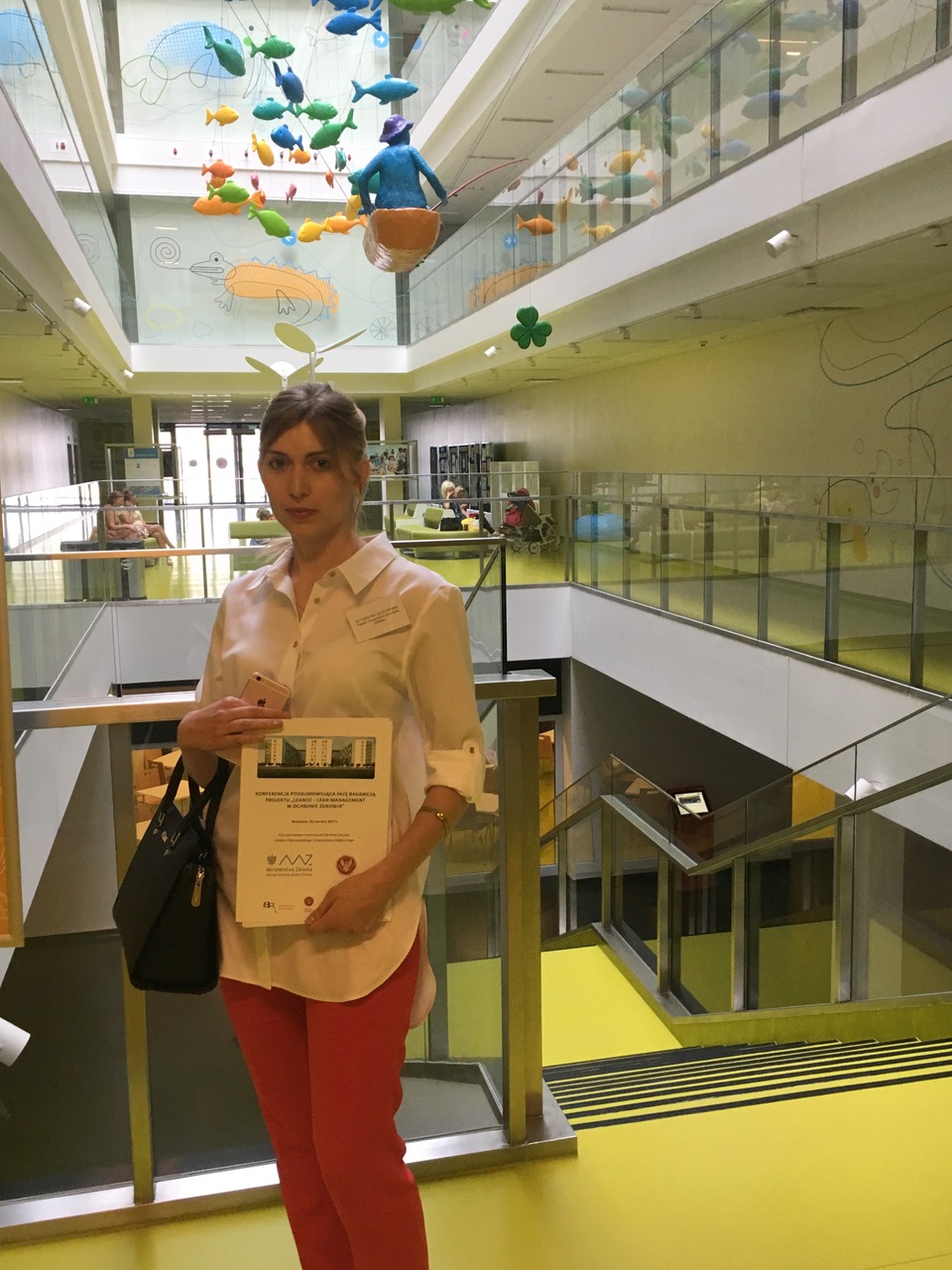
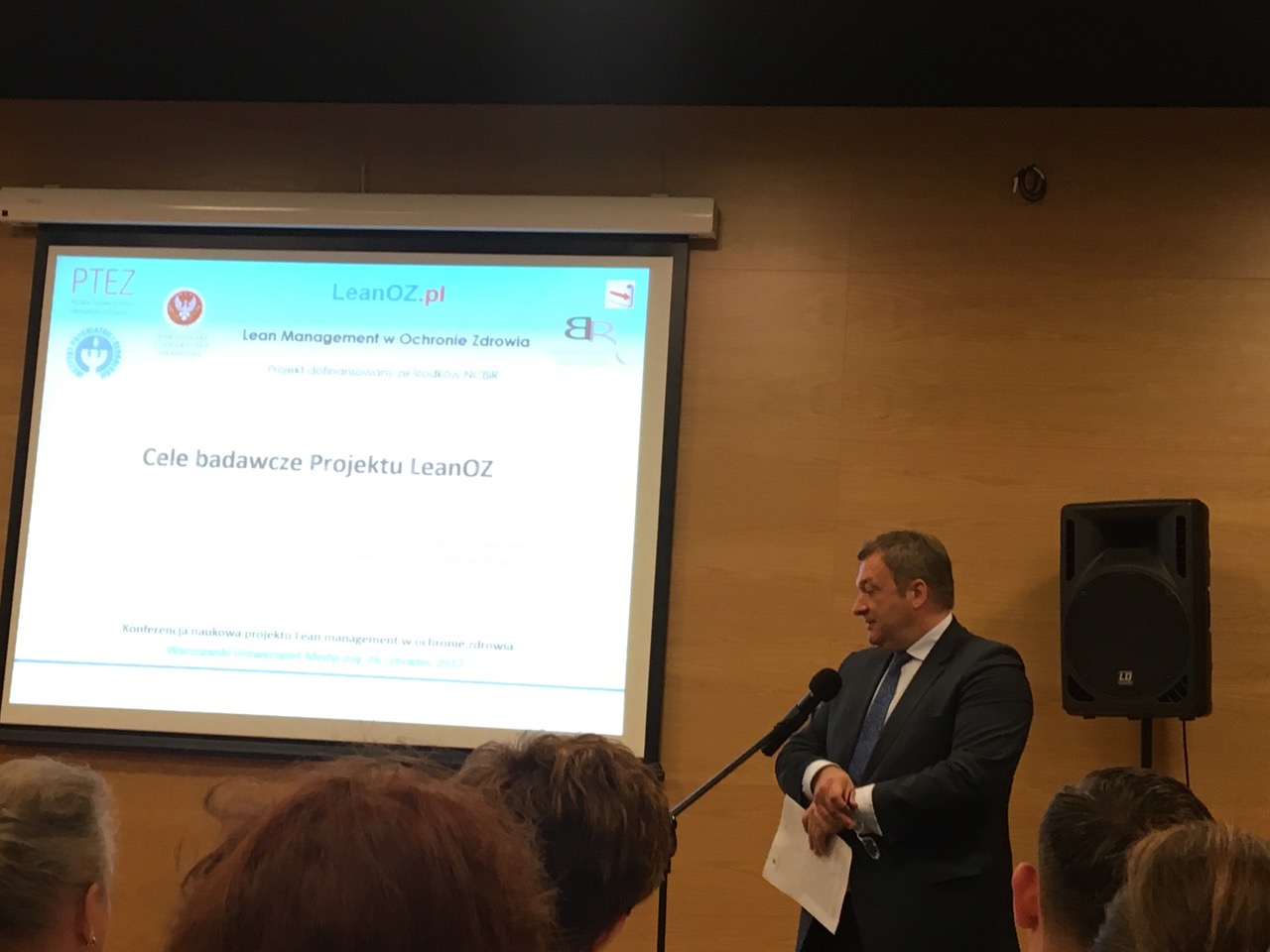
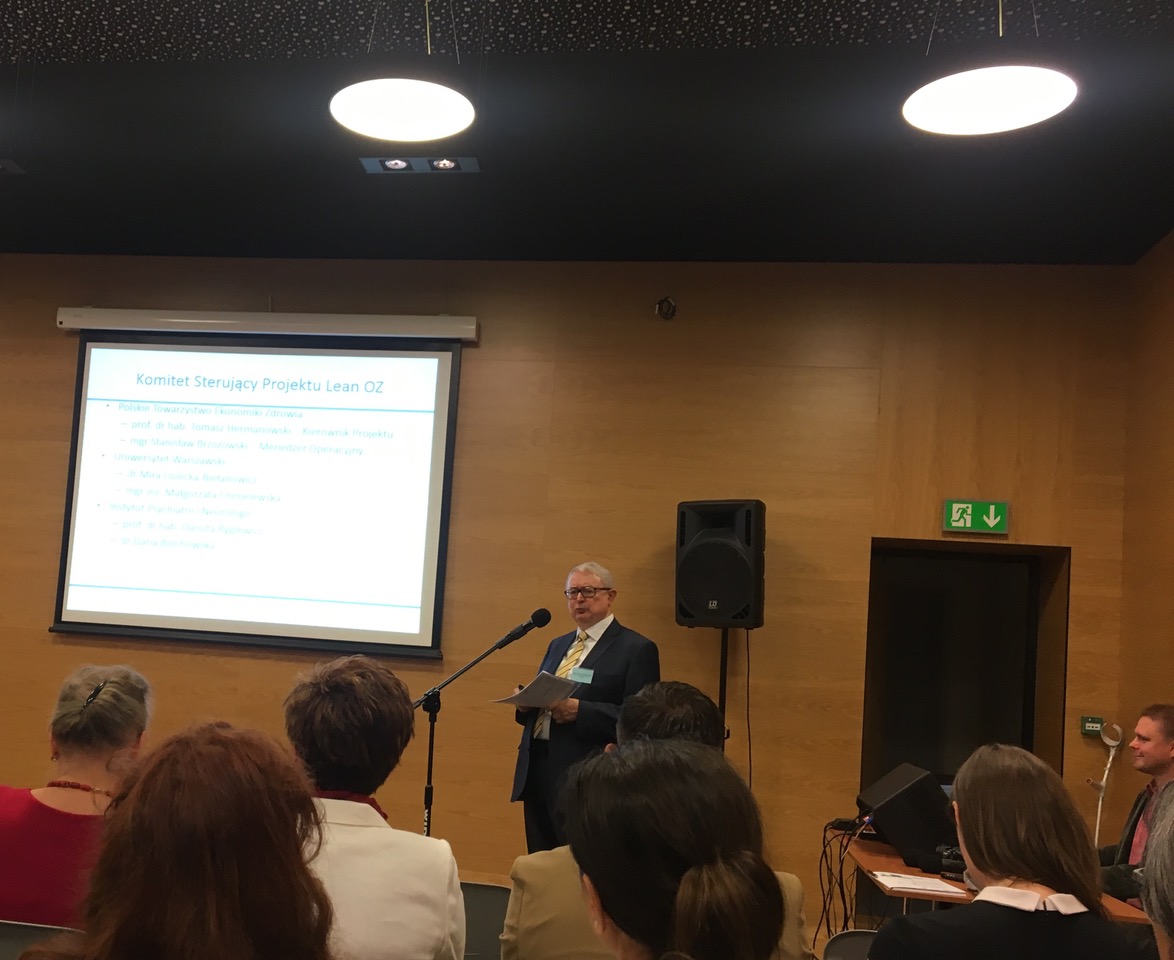
June 26 took place summative conference of research phase of project “LeanOZ- lean management in healthcare” which was organized by Polish Society of Health Economics. The conference was under the patronage of Ministry of Health in Poland and University President of Warsaw Medical University. In conference took part different groups, as medical staff, patients, healthcare managers, CEO of hospitals, representative of National Health Fund and The Agency for Health Technology Assessment and Tariff System. It was very interesting, full of know how event, where presented outputs from research phase of project.
This is approach which organizes clinical processes in innovative way, taking into account not just process costs, also safety of participants in process. Main goal to use this approach is to make shorter patient lead time in the process, in which is present value added without wastes. If we make shorter lead time, diagnosis can be made earlier, patient treatment is faster and place where medial services are available are organized better, in safety and efficient way.
Value stream mapping
During conference discussed lean in health care and need for using innovative approach in polish hospitals. Some subjects were presented in details, as:
- Critical parameters of brain stroke process treatment and possibilities of use lean management in brain stroke treatment
- Strengths and weaknesses of lean management approach in polish health care
- Local map of medical sources
- Standardization of places where medical services are present
- Actual state map and future state map
- Calculation of potential profits for lean healthcare implementation
Essential element concerned results of chosen lean healthcare tools implemented in:
- The Institute of Psychiatry and Neurology in Warsaw
- Medical-Diagnostic Center in Siedlce
- Emergency Department in Hospital Kopernik in Lodz
Based on searching and analysis prepared standards for value stream mapping in healthcare version 1.0, which are base for further discussion and possibilities of implementation this tool in polish hospitals.
Lean healthcare approach strive for improving clinical processes and:
- To interest of patient as main “aspect” in process treatment
- Elimination bottlenecks
- Better time management for medical staff and increase time dedicated for patient
- Make conform diagnosis and correct process treatment, without re-operation, complications and adverse events
- Appropriate mistake analysis and root causes elimination
- Optimal use of resources which are present in medical unit
It is worth to consider value stream mapping in own hospital. The results gives a lot of advantages and leads to improving processes. If process it well designed, patient receives treatment faster and medical staff can be more focused on concrete treatment, which let us to decrease risks.
Lean healthcare – how to implement it
Capable and efficient managing of patient treatment process has its own source in planning internal standards in medical unit. Medical services are diversified and it is hard to create just one, gold model of patient’s care. People are changing, also their experience and approach to services, levels of management in organization and characteristics of process, as KPI (key performance indicator) are follow to by top management. Each acts are basic for working according to law regulation and patient expectations. Striving for use the best world practices in daily work is difficult aim, but thanks to that high level of process maturity can be achieved. Health care is a part of industry and based on that economic development is defined.
Process mapping
To seek for fulfill clients – patient needs, potential patient, their families and relatives it is important to take into consideration not just financial indicators of medical unit, but mostly understand client and create medical processes, which have value added activities. This is a main purpose of lean healthcare.
For the body is health, for soul justice, nowadays Socrates words are still actual and value. There is nothing better than health, which defined as harmony between each parts of body –each of them performs important function. Also justice, which dispalys in different “parts” of souls. In order to fulfill need of body and soul during treatment, medical unit has challenge. The body – having appropriate infrastructure, modern and high tech medical equipment, qualified medical staff hospital can easily conduct operation or transplant for patient recovery. On the other hand the soul – meaning as fulfillment patient expectation is tricky aspect. Do long waiting time for medical counsel influences on positive patient mood? Do renewed treatment because of mistake gives patient feel comfortable and safety? Do lack of physician time for talk with patient ensure for easy and in peace treatment? The answer is: no. Hospitals can ensure the highest level of equipment and infrastructure, having enough financial resources, but patient feelings of stay in hospital can be negative, because of wrong planned treatment system. Do we have any solution?
Lean healthcare tools
Lean healthcare is an answer for “invisible part” of unit system organization. Using adequate tools, patient flow in the process can be improved ( value stream mapping). Then hospitalization time and waiting for procedures can be reduced. Participating actively in patient communication (communication with patient) we can acquire information, that reduce potential risks in the process. Treating every patient as a uniqe individual and with respect we can gain the trust and make better cooperation between patient and staff. Then treatment effects can be also improved. At the same time new approach of all employees according to kaizen philosophy – continuous improvement gives feeling of responsibility and co-determination about the processes and system. Kaizen box – is the toll for employee to generate ideas. It can be a simple start for lean hospitals approach. Using lean healthcare – lean hospitals practices shouldn’t be perceived as additional hard part duty in work, because it is a culture of behavior which can be obtained. Thanks to that it leads to better work organization and improvement of processes.
Outsourcing in hospital
How efficiently manage hospital? The way to improve medical processes – optimization healthcare processes – in hospital doesn’t consist of single action but it is based on defined tools and mainly organization culture. We should know WHY we provide services, and then how we are doing that. There is no lean healthcare without kaizen philosophy.
Does outsourcing in hospitals is cheaper solution than internal organization each departments, which are needed to functioning medical facility? What is process? It is set of activities, which are linked to each other, that develops inputs to outputs, creating value added. Well designed system of processes, causes that owners and participants know very well process, for which add value. Also they know internal client – other department. Not every hospital is aware about advantages of outsourcing – use defined external services, external suppliers for supporting core processes. Functioning medical unit consist of many processes (medical, management, educational), the most important one is clinical process. Clinical processes are the interaction between patient and personnel, as a results patient state of health is improved. For efficient realization of core processes, there should be identified supporting processes, without that organization couldn’t work. This processes can be: cleaning processes, laundering, feeding patients, accounting processes, human resources, pharmacy processes from which all medicaments comes from and other. Supporting processes as it is named, are dedicated to support core processes, thank to that organization can exist and have clients. These processes not always are fulfilled internal, but thanks to outsourcing services. What are main assets?
Outsourcing supporting processes is not just economic aspect. It is new level of quality. Cleaned, disinfected patients room according to hygiene plans and instructions, using appropriate fluids can reduce number of infections, improve level of patient safety. It is also less patient complaints, no delays in delivery, better communication and exploitation modern technology. Hospital im. Mikolaj Kopernik in Lodz saved up 1,6 mln zloty yearly thanks to outsourced cleaning processes [OSOZ, nr 6/2016, s.48]. Suppliers should be regularly evaluated, every claim or observation are motivators for improvement.
Having more and more duties in medical unit, it is desired to outsource some processes. External units are specialists in their area, which keep up to date with processes, thank to returns to scale it is possible to reduce costs.
Hospitals tour – Germany
During Second Polish – German Health Summit on 17-18.11.2016 participants have possibility to visit some hospitals. Group visited 3 hospitals in Germany:
- Greifswald University Hospital
- Heart and Diabetes Centre, Karlsburg Hospital
- AMEOS Hospital Anklam
Hospital in Greifswald was presented by Mr Marek Zygmunt. This medical unit has 926 beds for patients and it is clinical, multispecialistic, iniversity hospital, which enrolls 130 thousands ambulatory patient per year and 36 thousands stationery patients per year. This is very advanced complex of buildings, which also uses lean healthcare tools. Some of the building are far away of each other, even 300 meters, so that used pneumating tubes solution, which can send blood samples and drugs over 10m/sec. During weekends tak place about 20 to 40 teleconsultation, in professional adapted room. This is clinical process optimization. In many places we can meet visual management elements, as:
- 5S
- Defined material holding areas organization
- use of color for signs and marking
- different colours for blood samples
- procedures and instructions presented in more “user-friendly” way
- well designed layout/ infrastructure
- great signed corridors, showing direction
- using the most innovative logistic solution, as automated vehicle guided, for transport food, rubbish, bedding and more
- andon systems
Hospital in Karlsburg is modern place, which specializes in cardiovascular disorders and diabetes. Hospital was presented by Hospital Director, Prof. Dr. med. Hans- Georg Wollert. Every year 2500 cardiac and vascular surgeries and more than 5000 cardiological interventions are performed. 900 cases open heart surgery. About 2000 diabetes patients. Hospital has got modern operating theatre and use innovative valves. The oldest patient was 97 years old! This medical unit manage effectively of clinical processes, connlusion that conduct operation is cheaper and better that chronic patient treatment is real.
Next hospital was AMEOS Hospital in Anklam. We met with pleasant and warm reception. Top managements as well as medical staff were really involved in hospital presentation. Hospital dispose of 101 patient beds, also has implemented some solution from lean healthcare area:
- light and signal andon solution- opening door at every hospital ward
- 5S- well organized documents and forms and disposable materials
- Visual management, washrooms
In cocnlusion very hospital was big inspiration and fresh look for management, organization and approach for the patient, taking into account polish- german cooperation. Using len healthcare we can eliminate wastes which occurs in processes. It allows to reduce delays, raise level of quality medical services and shorten payment period for performed service. Listed above examples of visual management in practice evidenced that tool is also needed for reduction of “information deficit” in workplace [ Galsworth Gwendolyn, Visual workplace, Visual thinking (Portland, OR: Visual-Lean Enterprise press, 2005) 13]. It is important of process management and understanding client expectations. Not just end client but internal. Physician should organize his work in order to deliver service to patient in smoothly way, taking into account internal recipients and coworkers which contributes to process realization.
Managers of medical units should think about issues with lean healthcare approach. Think about:
- What problems are urgent and needed fast solution?
- If our problem is real problem?
- How current processes can be develop into processes with lean healthcare philosophy?
Second Polish – German Health Summit 2016
During 17-18.11.2016 in german city Greifswald took place meeting representatives of science, business and practice world. Very interesting programme provided everybody value informations and practical advices. The Second Polish- German Health Summit was organized in close cooperation with the State Chancellery of Mecklenburg- Vorpomern. It was taken at the University of Greifswald.
Chairs: Prof. Dr. Iga Rudawska University of Szczecin, Prof. Dr. Steffen Fleßa, University of Greifswald
Associate chairs: Univ. Prof. Dr. Jaroslaw J. Fedorowski, MD, MBA, Polish Hospital Federation; Dipl. Ing. Oec. Wolfang Gagzow, Hospital Federation of the German Land Mecklenburg- Vorpommern
First day was dedicated for presentations that concerns science and business life. Subjects of speeches were broadly defined of health care, mainly discussed good practices polish- german cross border – cooperation. Particulary interesting was presentation Mr Konrada Meissner i Lutza Fisher about cross – border emergency care. Next impressive lecture was prof. dr hab. Igi Rudawska about perceived service quality in chronic care- the empirical study. Next valuable presentation was that presented by Marcin Kautsch about development of e-Health in Poland from perspective of key stakeholders. Noticed that in Poland are presented e-registration and Electronic Health Record. Other solutions for data sharing as: telediagnosis, teleeducation, portable patient-monitoring devices, screening, telemonitoring can be meet in lower level. Speech of Marek Zygmunt about Assisted Reproductive Technology (ART) and cross border- cooperation raised current top issue. Other presentations were also very interesting and inspiring, were talking about data and facts that results from scientific research.
Lean Hospitals also was present and showed innovative approach to clinical process management using lean healthcare tools. What is clinical risk? Clinical risk means every risk, which negative influences at treatment results and quality requirements. Risk connected with medical services should be identified, under control, possible to avoid. In order to smoothly risk management, as first it is important to know all processes in organization. Then should be defined borders- start and end of the process. If process is defined better, it is lower risk level. Norms as PN-EN 15224:2015 Health Care services, Quality Management System, ISO 9001:2015, ISO 31000:2009, 31010:2009 contains requirements and rules, how organization should work to better manages their risks. Where find methods to manage more efficient? Lean healthcare – lean hospitals is an answer for that. Among other, you can use below tools and methods:
- FMEA- failure modes and effects analysis
- spaghetti diagram
- value stream mapping
- process flowcharts
- methodology 5S
- visual management
- ANDON system – sound and signal
- POKA-YOKE and JIDOKA solution
- medboards
- 5WHY
- Ishikawa diagram
- Pareto diagram
- Kaizen philosophy
In conclusion, if process are well known, their goals and client, it is possible to define potential risks. In order to appropriate risk management, norms, law and internal procedure should be followed to, therefore lean healthcare – lean hospitals tools should be used. This will improve processes – clinical process optimization. Philosphy Kaizen- “small steps” is basic to change culture of organization, company – hospital.
Nothing is particulary hard if you divide it into small jobs Henry Ford